
There is one word that has lost much of its meaning over the past decade: “green”. Used to describe everything from a skincare product to a pillow, or even an entire hotel, it has become an umbrella label under which almost anything can be placed – processes, intentions and, sometimes, nothing more than aspirations but not true sustainability practices based on data.
From 27 September 2026, using generic environmental claims without being able to substantiate them will become much more difficult. This is the effect of EU Directive 2024/825, known as the Empowering Consumers for the Green Transition Directive, implemented in Italy through Legislative Decree No. 30 of 20 February 2026.
For the luxury hospitality sector, where the relationship with guests is built in part on trust, this is better news than it may first appear.
What Changes with the Empowering Consumers Rules
Legislative Decree No. 30 of 20 February 2026, published in the Official Gazette on 9 March 2026, implements EU Directive 2024/825 in Italy, the so-called Empowering Consumers for the Green Transition Directive. As a result, the decree entered into force on 24 March 2026, while the new provisions will apply from 27 September 2026.
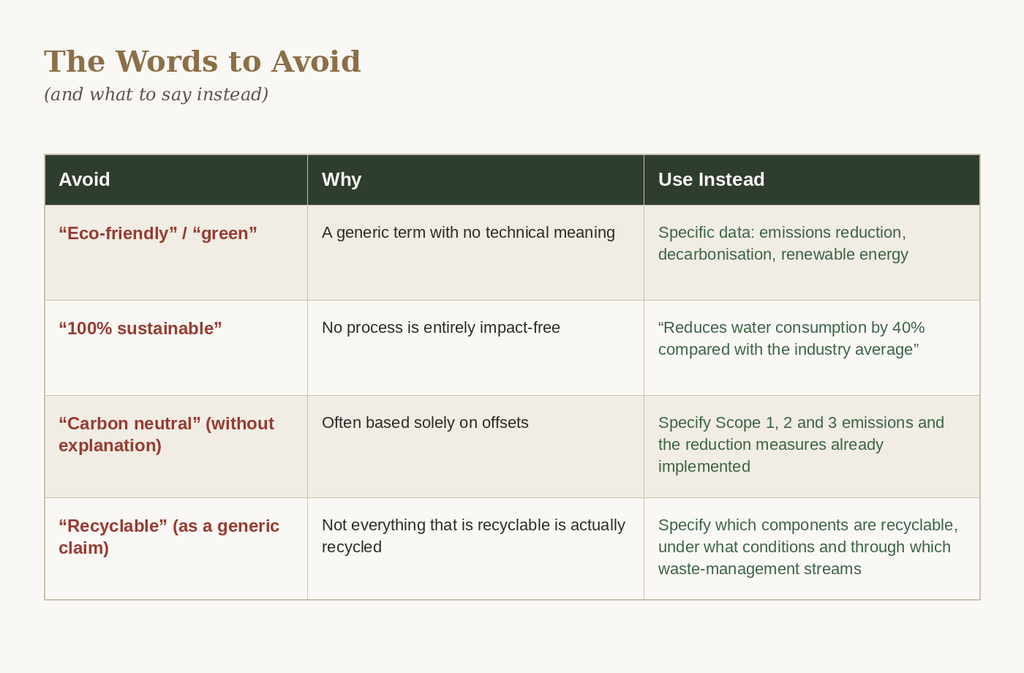
Importantly, the change is not about banning words such as “green”, “sustainable” or “eco-friendly” altogether. The point is a different one: environmental claims can no longer be used in a generic, ambiguous or inadequately substantiated way.
At the heart of the new rules, the guiding principle is simple to state, but less simple to put into practice. Any commercial communication that states or suggests an environmental or ecological benefit must be based on truthful, relevant and scientifically verifiable data, and must make it clear which specific aspect of the product or activity the claimed benefit refers to.
In this context, greenwashing is more clearly brought within the scope of prohibited or misleading commercial practices, strengthening consumer protection.
For a luxury hotel, resort or restaurant, this means that statements such as “eco-friendly hotel” or “zero-impact experience” are not automatically prohibited. But they will no longer be enough on their own. They must be supported by appropriate evidence and, where applicable, a recognised sustainability label or certification.
.
Practices the Directive Considers Unfair
The legislation expands the list of practices that are prohibited outright, without requiring proof that consumers were actually misled.
Among the most relevant for hospitality:
- VAGUE CLAIMS without a supporting sustainability label – “environmentally friendly”, “green” and “nature-friendly” are no longer sufficient on their own.
- GENERALISING A PARTIAL BENEFIT: presenting a claim that applies to one specific aspect as if it referred to the entire property or the entire guest experience – for example, renewable energy alone, when the F&B supply chain is not equally sustainable.
- CLIMATE NEUTRALITY BASED SOLELY ON OFFSETTING: claiming that a product or service has a “neutral”, “reduced” or “positive” impact in terms of greenhouse gas emissions when the claim is based on offsetting emissions outside the product’s value chain.
- SELF-CREATED SUSTAINABILITY LABELS that are not based on a recognised certification system or established by a public authority or independent body.
The common thread is always the same: proof, not vague promises.
Five Good Practices for Credible Sustainability Communication
- PROVIDE EVIDENCE.
Every environmental claim should be supported by verifiable data. A precise number is more powerful than an enthusiastic adjective. - MAKE CERTIFICATIONS VISIBLE.
If a property has obtained certification from an independent third party, make it easily accessible to guests – not hidden away on a secondary page of the website. - COMMUNICATE THE LIMITS, TOO.
Admitting that you are halfway through a journey – “this year we reduced plastic consumption by 25%; our next target is…” – is more credible than announcing an achievement that is never demonstrated. - THINK HOLISTICALLY.
Sustainability is not only about the environment. It also encompasses supply chains, workers’ rights, governance and the impact on local communities. After all, one “green” element does not make an entire property sustainable. - STAY CONSISTENT WITH THE BRAND IDENTITY.
The language of sustainability should be integrated into the overall tone of voice, not added as a separate chapter.
Why the right communication matters even more in luxury hospitality
In the hotel sector, exposure to the guest is direct and continuous.
For example, there is a significant difference between simply stating that a hotel is “green” and communicating that 100% of the electricity purchased comes from specific sources, that the property has reduced water consumption by a certain percentage over a defined period, or that it holds a specific sustainability certification awarded according to verifiable criteria.
The second approach does not automatically remove every verification requirement, but it makes the message more specific, understandable and demonstrable.
Hospitality therefore becomes a particularly demanding testing ground – but also an opportunity. Those who invest in transparent, measurable and well-substantiated communication will be one step ahead of those who continue to rely on generic claims after 27 September 2026 – and will also be better positioned to avoid the risks associated with non-compliance.
In the next article in our “Communication and Certifications” pillar, we will take a closer look at certifications – from ISO 14001 to EMAS, from GSTC to B Corp – to understand which standards carry the greatest authority and what they actually guarantee to those who obtain them.
Continue reading the next chapter of this series.